
 Free Delivery & Return
 365-Day Returns
 10 Million Happy Customers
 500,000 Products in Stock

How to Choose the Best Furniture for Your Dining Room
Reviewed by the Beliani Content Team · Updated November 2026
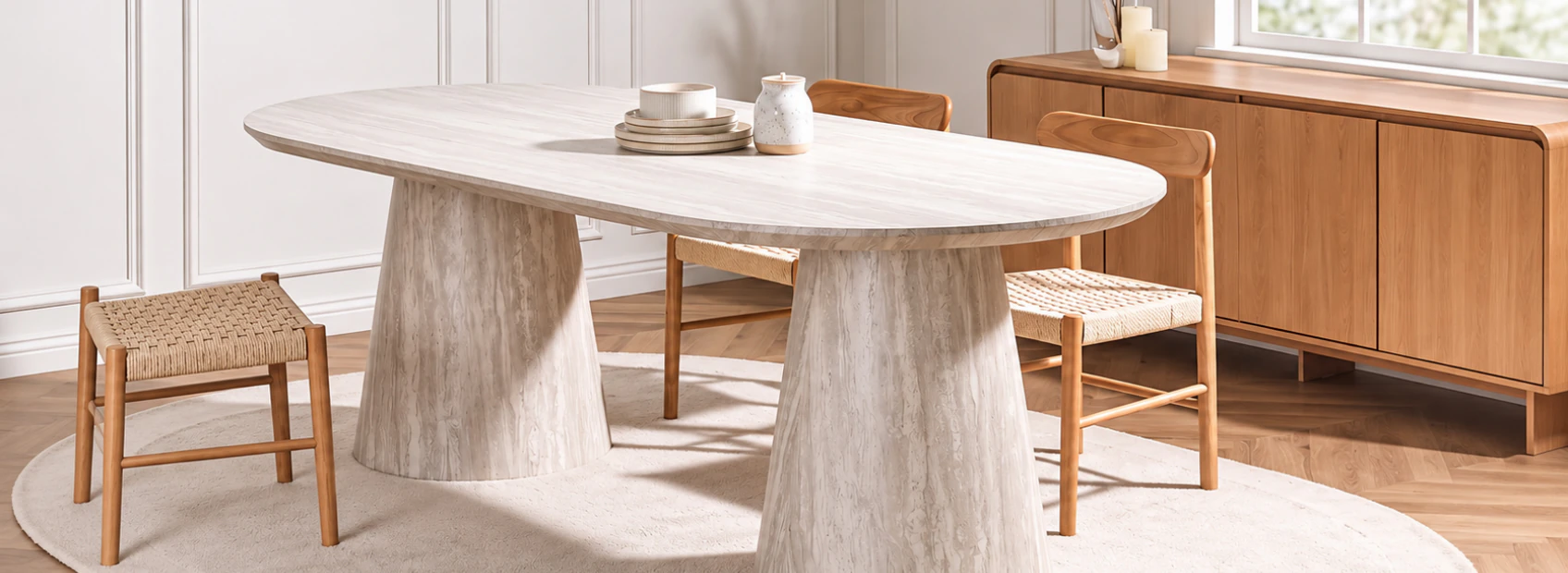
A dining room carries more daily traffic than almost any other room in the home, from quick breakfasts to the one evening a year you seat twelve people around the table. Getting the table, chairs and layout right is less about taste than about practical fit: a table a few centimetres too long for the room, or chairs that do not clear it when pushed back, will make the space feel cramped no matter how it looks in photos. This guide works through the measurements, materials and seating choices that make the difference.
In short
How much clearance does a dining table actually need?
Leave at least 90 cm of clear floor space on every side of the table so chairs can be pushed back and people can pass. Where anyone needs to walk behind a seated chair, increase that to 105-120 cm. For seating, budget at least 60 cm of table edge per diner, and closer to 70 cm if you want room for elbows.
- Room shape changes the answer: a long narrow room suits a rectangular table, a near-square room suits round or square
- Whether people need to walk behind seated diners during meals, not just reach their own chair
- Fixed table versus extending table, since the open length still needs the same clearance around it
Which table shape and size fit your room?
Measure the clearance from where the chair back actually lands at full pull-out, not from the table edge itself, since that is the real pinch point against a wall or sideboard. A table that fits the room on paper can still feel tight if the chairs cannot be pulled all the way out.
Compact rooms
Round tables
No sharp corners to clear when walking past, and every seat is an equal distance from the centre. Works well for four to six diners in a smaller or near-square room.
Larger groups
Rectangular tables
The most space-efficient shape for seating per metre of length. Suits a long room and scales easily from six to ten diners.
Symmetry
Square tables
Suits a small, near-square room and keeps the proportions balanced. Comfortable for four, tighter beyond six since the middle becomes hard to reach across.
Flexible seating
Extendable tables
Shrinks for everyday use and grows for guests. Available as round, rectangular or square tables, so it does not limit the shape you can choose.
If you are placing a rug under the table, let it extend at least 60-70 cm beyond the table edge on every side. That way all four chair legs stay on the rug even when a chair is pulled fully out, instead of catching on the rug's edge.
Read more: how to choose the right rug
How many seats do you actually need, and how far does an extending table get you?
Work out seating from the table's length, not from how many chairs look like they fit in a photo. At the minimum 60 cm per diner, a table 180 cm long gives exactly 60 cm each to three people along a side; at a more comfortable 90 cm each, the same table seats two per side. End seats can add one place at each end, but only if there is the same clear space behind the end chair as along the sides.
A built-in extension leaf typically adds around 40-50 cm of length, enough for one or two extra place settings, and most extending mechanisms are engineered to support the open top without needing extra legs underneath. If you only extend the table a few times a year, check how easily the leaf stores away, since an awkward leaf is the main reason an extending table stops getting used.
Read more: extendable dining tables guide
What table size do you need for your number of diners?
This quick reference uses the same per-diner space as above: 60 cm of table edge at the tight end and 70 cm for more elbow room. Figures are rounded and assume everyone sits along the long sides of a rectangular table or around a round one. The first figure in each row is a tight fit for everyday meals, the second is roomier.
| Diners | Rectangular table, length | Round table, diameter |
|---|---|---|
| 4 | 120-140 cm | 75-90 cm |
| 6 | 180-210 cm | 115-135 cm |
| 8 | 240-280 cm | 155-180 cm |
With an end seat at each end, a 180-210 cm rectangular table seats eight instead of six. For an extending table, use the open length. To find the smallest room that keeps 90 cm clear on every side, add 180 cm to the table's length and to its width, and allow more where people walk behind seated diners. Beyond eight diners, a rectangular or extending table is easier to live with than a round one, because the middle of a large round table is hard to reach across.
How does the table base affect seating and legroom?
Two tables of the same size can seat different numbers of people, because the base decides where chairs and knees can go. Check how the legs or column are set before you count seats.
Corner legs
Four-leg tables
Legs at the corners can get in the way of chairs placed near the ends of each side, so the usable edge is a little shorter than the full length. Allow for this if you plan to seat the maximum number.
Centre column
Pedestal tables
With no corner legs, chairs can sit anywhere along the edge, which works especially well on round tables. Check the width of the base on the product page, since a wide base can limit legroom near the centre.
Set-in legs
Trestle and panel tables
Legs set in from the ends leave the corners and end seats free. Look at any crossbar or panel between the legs, since it can limit foot room for the people sitting nearest to it.
Whichever base you choose, also look at the depth of the frame under the tabletop: a deep frame can reduce knee room.
Which dining table materials and finishes last through daily use?
The tabletop material, or the finish applied over it, decides how well a table takes daily use and how much care it needs. Some entries below are materials in their own right; others are finishes applied over wood or an engineered core.
| Material or finish | Durability | Maintenance |
|---|---|---|
| Solid wood | Very high when sealed; hardwoods such as oak, walnut and beech resist dents better than softwoods such as pine. | Occasional reoiling or polishing, depending on the finish. |
| Veneer over engineered wood | Good for the core structure; the surface layer can chip or peel if treated roughly. | Wipe clean, avoid letting moisture sit at the edges or seams. |
| Paper veneer | Fair for everyday use while the protective coating is intact; the printed paper layer is thin, so it takes rough treatment less well than real wood veneer. | Wipe with a dry or lightly damp cloth and keep moisture away from the seams, where it can lift the paper layer. |
| Laminate | High; the tough printed surface resists everyday scratches and stains, but it cannot be sanded or refinished if it is damaged. | Wipe clean with a damp cloth; no oiling or polishing needed. |
| Painted finish | Fair to good; a solid colour over a wood or MDF base gives a clean, uniform look, but paint can chip at edges and corners under heavy use. | Wipe with a soft, damp cloth and avoid abrasive cleaners, which can dull or scratch the paint. |
| Lacquered finish | High; a hard glossy or matt topcoat over wood or MDF seals the surface and resists moisture well. | Wipe with a soft cloth, avoid abrasive pads and use coasters to prevent heat marks. |
| Toughened glass | Very resistant to scratches; will not warp or stain over time. | Shows fingerprints and watermarks, so it needs more frequent wiping. |
| Metal | Very high; rarely the part of the table that wears out first. | Powder-coated finishes resist chipping better than painted ones. |
Which chair type suits daily use - upholstered or not?
Upholstered chairs are more comfortable for long meals but pick up marks and wear faster under daily use. Non-upholstered chairs in wood, metal or moulded plastic wipe clean in seconds and hold up well to spills, but become less comfortable the longer people sit in them.
A quick rule for busy households
If the table sees daily meals with children or pets, a wipeable synthetic leather or a tightly woven performance fabric copes far better than a loose-weave fabric or genuine leather, both of which mark more easily under everyday wear.
Which functional features are worth looking for?
Beyond the seat and upholstery, a few mechanisms decide how easily a dining chair fits daily use around the table.
- 360° swivel base: turns freely on the spot instead of needing to be pulled out, which makes sitting down and standing up easier in a tight spot, such as beside a kitchen island or in a narrow dining area.
- Castors or glide feet: let the chair slide in and out smoothly instead of scraping. On hardwood or tiled floors, check for soft, floor-friendly castors or felt glides, since hard plastic wheels can mark softer flooring.
- Stacking or folding frames: free up floor space quickly when chairs are not in use, which suits a small dining room or a table that is only fully seated on occasion, such as for guests.
- Armrests: make sitting down and getting up more comfortable, but check they clear the table at the chair's actual seat height, since armrests that sit too high for the table apron will stop the chair tucking in fully.
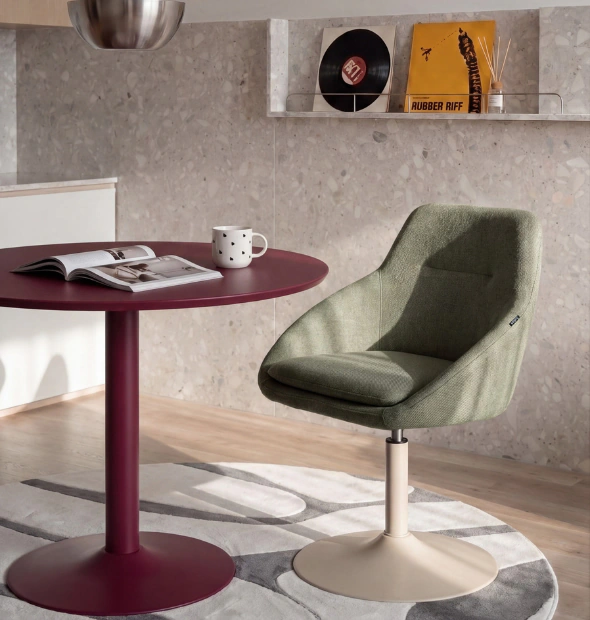
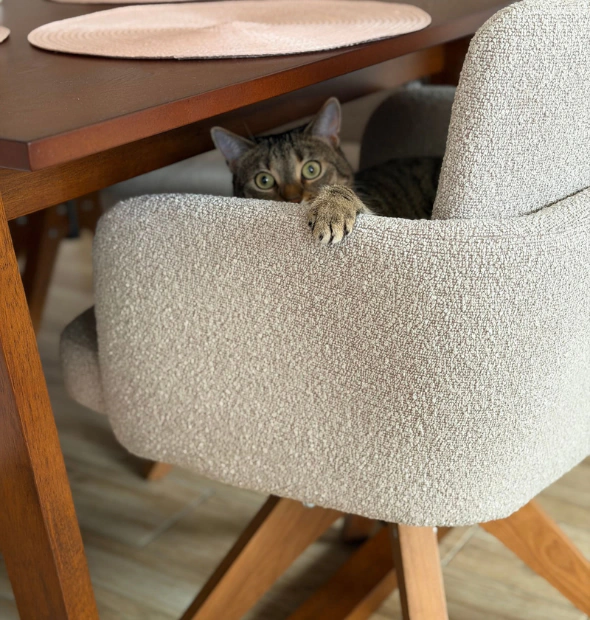
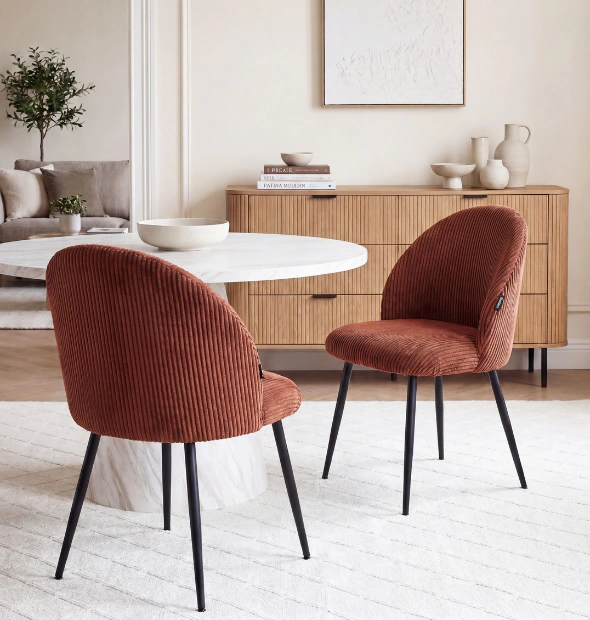
Shop now: products in the pictures
Read more: how to pick the perfect dining room chair
How do you furnish a small or open-plan dining area?
In a small room, the 90 cm clearance rule is usually what limits the table, so choose the table to suit the room first and the number of seats second. Open-plan rooms have the opposite problem: with no walls to anchor the table, the dining area needs defining.
- Choose a round or pedestal-base table where space is tight: there are no corners to walk round and no corner legs to plan chairs around
- Keep an extending table closed day to day, and check that its open length still leaves 90 cm clear on every side before you buy
- Pushing a table against a wall frees floor space, but you lose the seats on that side, so it suits everyday use better than hosting
- In an open-plan room, a rug under the table and a pendant light above it mark out the dining area without any walls
- Keep the 105-120 cm walkway wherever people pass behind seated diners on the way to the kitchen or the sofa
How do you fit dining room storage around the table?
A sideboard, buffet or cabinet keeps tableware, linen and serving dishes within reach of the table, but it also takes up part of the clearance you have planned. Measure the free space from the chair back at full pull-out to the front of the unit, with its doors or drawers open.
- Check the depth first: a shallow sideboard costs less floor space, so it suits a narrow room
- Sliding doors need no swing space, which can help in a tight room
- Tall, narrow cabinets and wall shelves use height instead of floor space in a small dining room
- Glass-fronted display cabinets suit glassware and china you like to show off, while closed doors hide everyday items
How do you choose a style for your dining room?
Settle on a direction before you shop, since it is far easier to change a lampshade later than a table. Modern, farmhouse, traditional and transitional are common starting points, and most rooms work best when the large pieces (the table, chairs and any sideboard) share one direction while smaller accessories add variation.
- Choose your table and chair finish first, since these are the hardest and most expensive pieces to replace later
- Pick a neutral base palette for large pieces, then use accessories for colour and personality
- Keep lighting, tableware and soft furnishings loosely within the same style family so the room reads as one space
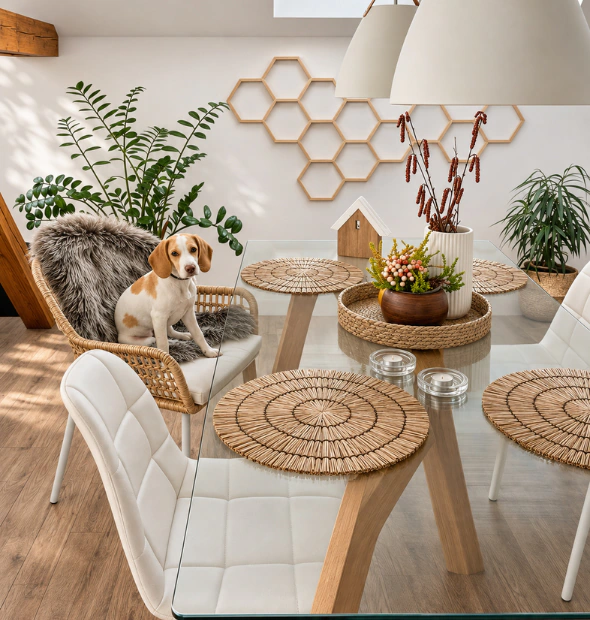
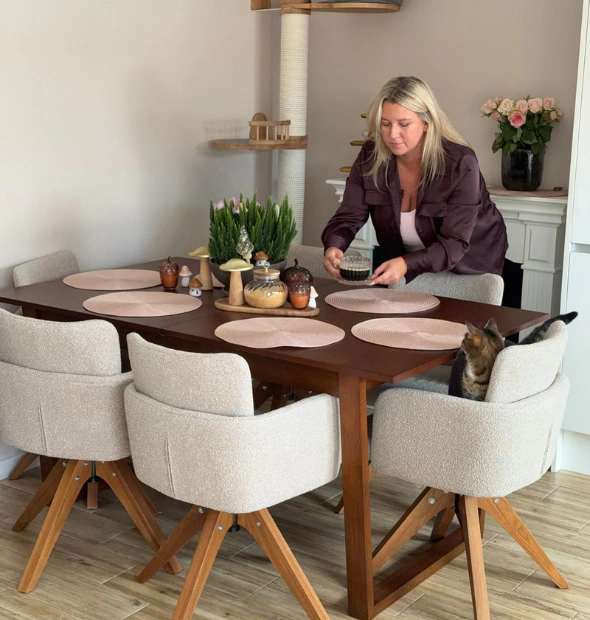
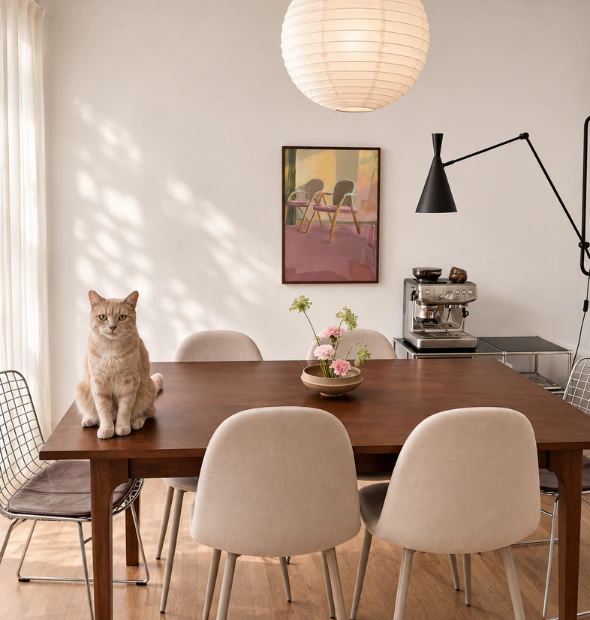
Shop now: products in the pictures
Which finishing touches complete the dining room?
Lighting, tableware and storage finish the room once the furniture is settled. A centrepiece, table runner or seasonal decoration is the easiest way to refresh the look without replacing anything.
One thing worth getting right
Hang a pendant or chandelier around 70-80 cm above the table surface, a little higher under a high ceiling, with a warm 2700-3000K bulb, so the light pools on the table rather than in people's eyes.
Shop now: dining room accessories
What to check before buying dining room furniture
Work through these in order, from the room itself to the smaller details.
- Clear floor space on every side of the table: at least 90 cm, and 105-120 cm anywhere there is foot traffic behind a seated chair
- Seat width: at least 60 cm of table edge per diner, measured along the side you plan to seat people
- An extending table's open length, checked against the same clearance, not just the closed length
- Table base: where the legs or column sit, compared with where you plan to place the chairs
- Chair seat height against table height: a seat height of 45-46 cm with a table height of about 75 cm is the standard pairing
- Chair functions, such as a swivel base, castors or a stacking frame, that match how often the chairs are moved
- Table surface material and chair upholstery against real daily use: heat, knives, spills and wipe-downs
Frequently asked questions
Does a glass-top table work with any style of base?
Glass pairs well with most bases, including wood, metal and rattan, since the transparent top keeps the visual weight low and lets the base carry the style. It suits modern, Scandinavian and industrial rooms particularly well, and most glass dining tables use toughened safety glass, so check this on the product listing before buying.
Is a bench a practical alternative to chairs?
Yes, a bench on one side of the table seats more people in the same length than individual chairs do, and it tucks fully under the table when not in use, which helps in a small dining room. It is a less comfortable choice for long meals, though, so many households pair a bench on one side with chairs on the other.
Do I need a protective pad or tablecloth for a solid wood table?
Not strictly, but a placemat or coaster under hot dishes and wet glasses protects the finish from heat marks and ring stains. Most solid wood tables are sealed with a lacquer or oil finish that resists everyday use without a permanent cover.
How long do dining chairs usually last?
A well-made dining chair with a solid frame can last for many years of daily use. It is usually the upholstery that wears first and needs re-covering or cushion replacement long before the frame itself gives out.
Can I mix different dining chairs around one table?
Yes, as long as the seat heights are similar, so everyone sits at a comfortable height to the table. To keep the look deliberate, share one element between the chairs, such as the colour, the material or the leg finish. A simple approach is to put a different chair, such as an armchair, at each end and matching chairs along the sides.
Will a large dining table fit through my doorways?
Check the packaged dimensions listed on the product page, not just the size of the finished table, and compare them with the narrowest points on the delivery route: doorways, hallways, stairs and tight corners. It also helps to leave space in the room to unpack and put the table together.
