
 Free Delivery & Return
 365-Day Returns
 10 Million Happy Customers
 500,000 Products in Stock


Shelves and Shelving Units


Shelves and Shelving Units
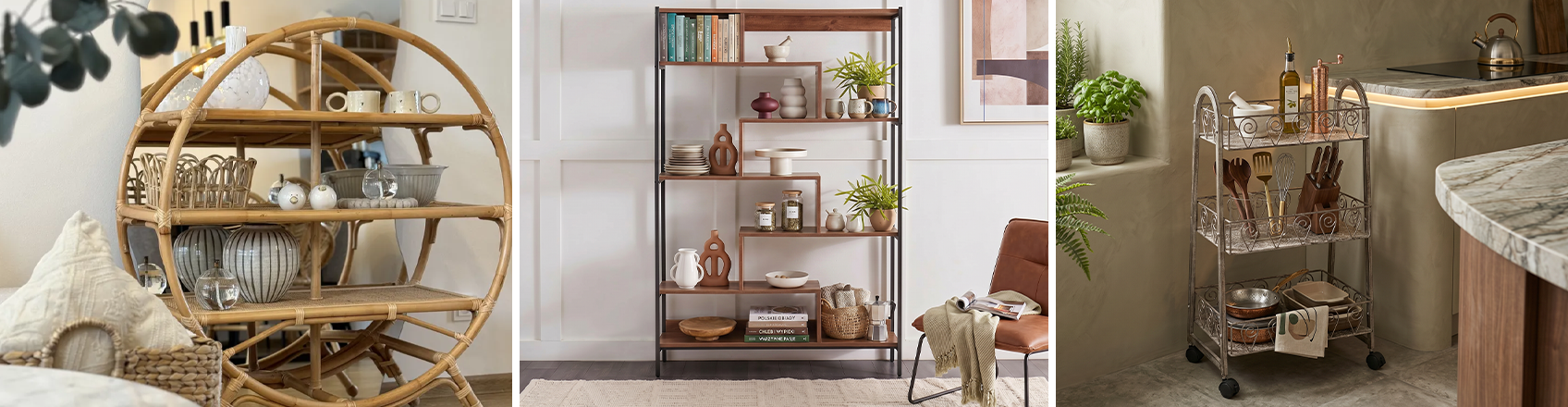
Kitchen shelving solves two problems at once: it adds storage without taking up floor space, and it brings things out into the open where you can actually see and reach them. The result is a kitchen that's easier to use and, if you choose what goes on the shelves with a bit of thought, more interesting to look at too.
How do you work out how much shelving you need?
A useful way to think about it is to identify what's currently living in cupboards that you open multiple times a day. Those are the things that would work better on a shelf — visible, reachable, and not buried behind other things. If the answer is quite a lot, a full shelving unit with multiple tiers gives you the capacity to bring a meaningful amount of storage out into the open. If it's just a handful of everyday items, a single shelf positioned at the right height will do the job without taking over the room.
It's also worth thinking about depth. Kitchen shelves don't need to be as deep as cupboards to be useful — a shallower shelf actually works better for most kitchen items because nothing gets hidden at the back. Plates, jars, bottles, and cookbooks all sit comfortably on a shelf around 25 to 30cm deep, and the reduced depth keeps the shelf from making the kitchen feel narrower than it is.
What actually belongs on a kitchen shelf?
The most useful things to keep on open kitchen shelves are the ones you use regularly enough that having them visible saves you time, and attractive enough that you don't mind looking at them. Oils, vinegars, and condiments you use daily are a good starting point. Cookbooks earn their place on a shelf far better than they do buried in a cupboard, where they rarely get opened. A small collection of mismatched ceramics, a plant, or a few jars of dried goods all add character without requiring any particular styling effort.
The one thing worth avoiding is treating shelves as overflow storage for things that don't fit anywhere else. Open shelving only works well when the contents are edited down to what's genuinely useful or genuinely worth displaying. Everything else is better behind a door, and keeping that distinction clear is what makes open shelving feel curated rather than cluttered.